Showing posts with label Austria. Show all posts

Tuesday, June 23, 2015

So Long, Farewell


It's hard to even process five months of living in Vienna. I’ve written this post so many times, but there just isn’t a perfect way to sum up everything that has happened. There’s so much. I know that I’ve changed, but I can’t really tell how much until I’m back home. But I want to at least try to reflect on what my time here has meant to me.

It’s clear to me that coming to Vienna this semester was exactly the right choice for me. Sure, there were challenges. My Southern self had to learn how to navigate the cold. I had to say goodbye to everyone I loved and start from scratch meeting people and making friends. But this was unmistakably the place where I was supposed to be. I learned so much, not only in my classes, but also about myself.


I learned what my view of the world looks like from the outside. I used to think Texas meant football and the Lone Star State. But to people here, Texas means guns and cowboys. So many people asked me if I owned a gun, it was hilarious. Sure, I’m still a tacky American who uses her credit card too much and likes bacon with breakfast, but I am more aware now that my brand of “normal” is just one of many.


General life skills should have been on my syllabus this semester as well. When I first showed up, no one could understand my colloquialisms. But now I've learned to communicate better with people from other cultures. The time I stood at the post office desk for a good three minutes trying to mime-ask how to use a stamp should count for three hours of cross-cultural communication class.


And I can take care of myself in the big city now. The number of times I’ve gotten off at the completely wrong Ubahn station has dramatically decreased since February. I can even read the signs so I don’t spend an hour confused because I took the wrong exit out of the station. And I am quite accustomed to the strange things that might happen while on the train. Like the cat who rode the train one day, or the woman carrying a live lemon tree. So I feel like I’ve got city life under control. Which gives me confidence that no matter where I end up in life, I'll be able to make it work.


In general I feel more confident than I have before. Moving to a foreign country presents a thousand tiny challenges every day in the beginning, but now that I have overcome those, I feel like I can take on the world.


The city of Vienna itself has also been my classroom. I've learned about architecture on its streets. I've gone back in time through the palaces and museums to experience its history. And most of all Vienna has taught me about what it means to take time to enjoy life. The culture here does not encourage hustle and bustle. If something is pleasant, you should savor it. Five months ago I would have never believed that I could sit in a coffee shop for two or three hours, just sipping a drink. I had this idea that if I wasn’t busy all of the time, then I would notice how far away my friends and family were and feel lonely. But that wasn’t the case. I calmed down, and finally learned how to relax. There were definitely many times when I missed family and friends, but constant motion wasn’t the best distraction.
 
Architecture with Otto Wagner

Museum of Vienna
Sipping in style

And while I am sitting here, thinking about all of the good times I’ve had, I would be remiss if I didn’t thank all of the awesome people who made it so. You were such good friends to me during my time here. I had so much fun hanging out with you and learned so much from you. I just hope we will see each other again.


Saying goodbye is always hard. There are just no words. But I know that Vienna, and the people here, have left their mark on me. I'm going back home a different person after everything I’ve done and learned on my study abroad journey. A little more relaxed, a little more confident, and with a whole new perspective on life. So, with many thanks left unsaid, it’s time to say Auf Wiedersehen.

Thursday, June 4, 2015

Taking Time to Be a Tourist


A few weeks ago, my parents came to visit me here in Vienna. They were here a week, which gave me my first real chance to drop everything and just tour Vienna. Before I had tried to see a site here or there, but was also going about daily life. Now I could marathon them all.

We had so much fun exploring the city!  I was their personal tour guide for the week, and we took the “E for everything tour”. That meant I got to see a few places that were still totally new to me. It’s fun to experience the places I’ve been before with my parents, but it was extra fun to try a few new things.

For as long as I have been in Vienna I have been meaning to go to the Belvedere. Eventually, I just decided to save it for my parents’ trip because I hadn’t gotten out there yet. We saw both the Upper and Lower Belvedere. They were built as a palace for Prince Eugene of Savoy in 1723. The Upper Belvedere didn’t stay that way for long, however. Pretty soon it was turned into the imperial painting gallery. It is still an art museum today. 

Visiting the galleries at the Upper Belvedere was pretty awe-inspiring.  Hanging art on stark white walls just isn’t the same as displaying it in a palace. And the palace is so intricate and beautiful inside. Some of the rooms are more plain, but there are quite a few showpiece rooms still left. Check out the marble hall, for example.

One of my favorite moments was when you first enter, there is this white, marble entrance hall with these magnificent, elaborate columns and in the middle was an inflatable Hulk by Jeff Koons. It was a bright pop of color in contrast with the hall. 
Copyright: Belvedere Wien No pictures allowed


  The collection of artwork inside was very nice. It covered quite a long time period, from medieval art all the way to impressionism and the Viennese Secession. The main event, of course, is their collection of works by Gustav Klimt. This included the famous “Kiss” painting, along with many other works. My mother is very into art and art history, so it was especially fun getting her take on many of the paintings featured. 
Seeing the galleries of the Upper Belvedere was great. The Lower Belvedere was cool too. There was an exhibition on the Vienna Congress of 1814 and some more fancy rooms. What made our trip out to the Belvedere more special, however, were the fabulous gardens. Everything that you could wish for in a baroque garden was there: decorative floral arrangements, fanciful fountains, and tree-lined walking paths. All framed by the two gorgeous Belvedere palaces. What a nice place for an afternoon stroll. 


While my parents were here I also wanted to make sure to take them to one of Vienna’s famous concert cafes. And there was one in particular that I had not visited yet, the famous Café Central. It opened in 1876, and has seen its fair share of celebrity guests, including Sigmund Freud, a popular figure in twentieth century Viennese cafes. We went one evening to hear the live piano music. Nothing tops sitting in a beautiful café listening to live music and sipping coffee. And Café Central was certainly beautiful inside.


 Another major bucket list item for all visitors to Vienna that I had not accomplished yet was seeing the Lipizzaner stallions at the Spanish Riding School. Due to time constraints, we decided it would be best to go to the morning exercises. Pictures weren’t allowed, as they might disturb the horses. So you will just have to trust me that this was the fanciest horse arena that I’ve ever seen. There were statues and stucco on the ceiling and red velvet. Nothing like a rodeo in Texas.

The stallions were impressive as well. We watched them being trained. They were so graceful and precise. There is a special stance that they have to maintain as they do different runs and gallops. It was really remarkable and fascinating. You can see the promo clip here. Many people didn’t stay for the whole two-hour show, but we definitely did. They played “Viennese music” from Mozart, Strauss, etc. the whole time. Of course the end was the Radetzky March. We couldn’t clap because of the horses, so we all golf clapped along. 

Showing my parents around definitely helped me cross lots of things off of my bucket list. I only have three weeks left in Vienna now. Where does the time go!? But I was a bit homesick. So, seeing my parents was a real treat. These new highlights were just the cherry on top.


Saturday, May 30, 2015

How to Meet Locals While Studying Abroad


It might seem like I’ve been spending all of my time lately traveling. And I have been traveling a lot! But also part of study abroad is to experience the local culture. I was worried when I came to Vienna that I would end up only hanging out with other American students. That’s what everyone warned me not to do. It turned out to not be a huge problem. Here’s what has helped me get out of my comfort zone and make some new friends from new cultures.

The most important thing to remember is not to be afraid to fly solo. You will have to do some things alone. It will be okay. I promise along the way you’ll meet amazing people. But a huge group of friends is hard to approach, and being a part of a huge group is easy to get comfortable with. As just one person it is easier to meet people in classes, at events, and wherever you happen to be. Getting out of your comfort zone is what it’s all about. The risks might seem big, but the rewards are bigger.

So, once you’ve decided to take the leap and try something new, what do you do? Where can you go to meet people? Classes can be a great way to interact with locals, but there are lots of other options as well.


·      Take a look at the services offered by your host university. WU has a buddy program that pairs incoming international students with regular WU students who can help show them around. I was paired with a fabulous buddy. She has been really helpful, giving me advice about what to do around Vienna. We try to meet every other week or so to at least grab coffee and chat.

There is also a program at WU that matches students with conversation partners. The partners then practice their language skills. Again, I was lucky and have a great partner. We meet once a week to practice talking in English and German. Sometimes we meet on campus and have serious sessions. But other times we go somewhere in the city to hang out or grab ice cream.

Try to see if your new university offers anything like a buddy program or a language exchange. The structured setting can be helpful if you want to meet people, but you are naturally shy.

If you’re still searching for ways to meet people, the best way I’ve found is going to events. That way you are guaranteed to have something in common with everyone you meet, since you all decided to go to the same event. But finding out what is going on in a new city can be a bit tricky. Luckily, there are several options for places to look.

·      Search Facebook events. Chances are, wherever you are studying abroad, there is a lot going on. Here in Vienna there are a ton of events every day. I use Facebook’s events feature to browse what is going on. The ability to see what all my friends are interested in going to is great. Plus, the search feature lets me look up events that I’m interested in. What are your hobbies? Look for events related to that in your area.

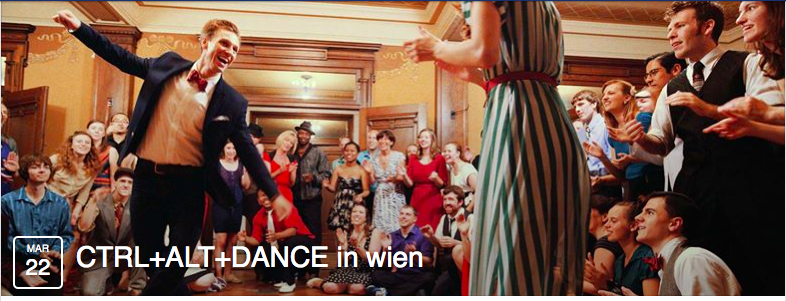
For example. I like to go swing dancing, so I just typed “swing dance Vienna” into the search bar. I found a cool movie premiere/dance event to go to. While I was there I met some nice people who told me about other dance events in the city.


·      Look around the web. Meetup.com is another place online to look for events. People and organizations post about things that are happening, so people can meet up. Through the site I found a regular board game night at a local game store. I go every week now, and have made some great friends there.

Of course, there are non-internet ways to find out about what’s going on as well. Posters around town often tell about the best events. It comes down to finding something that sounds fun to you, and just going for it. So be bold, get out there, talk to people, and have a great time!

Monday, March 30, 2015

Vienna City Hall Tour: a Free Suprise


I am always on the look out for free things to do in Vienna. There is never a shortage of activities, but sometimes I don’t feel like doling out Euros right and left. So, when I learned that the Weiner Rathaus (Vienna City Hall) offered free tours every Monday, Wednesday, and Friday, I had to check it out.

From the outside, the Rathaus looks more like a giant castle, or maybe a church, not a city hall. The building is huge. It is 152 meters long and 127 meters wide, and one of the biggest city halls in Europe. The inside is just as grand as the outside. The whole building was designed by famous German architect, Friedrich Schmidt. He had designed several other buildings in Vienna before he won the contest to design the new Rathaus. In 1883 he was even made an honorary citizen of Vienna, and he has his own statue in a park outside.

Our tour started in the Arkadenhof (Arcade Courtyard), the largest of seven interior courtyards of the Rathaus. In the summer it is used as a festival ground, and even features a foldout roof, in case of rain.

Then we proceeded up the Grand Staircases. These are two magnificent red-carpeted staircases leading up to the Festival Hall. On either side they are flanked by beautiful stained glass windows. Walking up the stairs reinforces the idea that this is not just any old city hall.

The Festival Hall is an event venue, which in Austria means a ballroom. When it was completed in 1883, it was the largest hall in Austria with 1,450 square meters of floor space. The vaulted ceilings, with their 16 gilded chandeliers lend the room an even greater level of grandeur. Every winter the Ball of the City of Vienna is held at the Festival Hall. And in the summer the lively Life Ball takes place here. The first ball here on February 12, 1890 featured performances by the waltz master himself, Johann Strauss II.


Next we visited the Wappensaal (Coat of Arms Hall), two rooms used for honorary ceremonies and events. They used to be home to a weapons collection, but it has since been relocated to the Municipal Arms Museum. The walls are still decorated with hangings representing the coats of arms of the nine Bundesländer (federal provinces) of Austria and their capitals. Another impressive feature are the 500 and 750kg crystal chandeliers in the two rooms.


Our last stop was the two story Council Chamber. They really pulled out all the stops for this one. The vaulted ceilings are adorned with 22-carat gold. There is a precious wood inlay ceiling, stained glass windows, frescos, and a 3,200kg chandelier. The chandelier was presented by Friedrich Schmidt at the International Exhibition in Paris. It is so heavy that it had to be anchored to the roof with steel cables and the ceiling put in afterwards.

Fresco of Maria Theresa
There was one more cool thing to see before our tour officially ended. Atop the tallest tower of the Rathaus stands Rathausmann. Why is there a statue all the way up there, you may ask? Well, there are two reasons. One, he serves as a metal lightning rod. Two, the law in Vienna at the time stated that no secular building could be taller than a church. The spires of the nearby Votivekirche are 99 meters tall. Naturally, the Rathaus tower is only 97.9 meters high. Except, when you add the 5.4 meters for Rathausmann. So, he was a sneaky loophole.

Can you spot Rathausmann?
The exterior of the Rathaus is quite the sight. Surrounded by parks and the famous Ringstraße, it offers visitors plenty to soak in. But that is only half of the story. I was really surprised by how exquisite and interesting the interior of the Rathaus was. Every room had beautiful decorations and a story to tell. And they are still in use today. That is why visitors have to take a guided tour. There are still government officials conducting business in the building. For me, it was quite an experience to see how a building so connected to Vienna’s imperial past was being translated into its present.

I think the Rathaus tour might be one of Vienna’s hidden gems. I hadn’t heard about it anywhere until I read the small print on my map, but it was a great tour. They offer audio guides in lots of languages, so anyone can go. I highly recommend checking it out.

Let’s Get Down to Business School


This may shock some of you, but I have now completed my first class at WU. I know what you are thinking, classes only started a few weeks ago, how could one be over already? That is the magic of block schedules.

Now that I am getting used to my new classes, I thought it was a good time to share a little about the differences between WU and USC. In a lot of ways it is very different, but of course, there are lots of similarities as well.

I’ll start with the campus. Both schools have beautiful campuses, but WU’s is much smaller. This is because the university only offers majors and courses of study in business and related topics. Anyone studying art, history, science, or engineering goes to another university entirely. Therefore, they need fewer buildings. They also don’t offer on-campus housing, medical care, and there is only a small sports facility.

In South Carolina, the campus is designed to function as a city within a city. You don’t ever need to leave. Here, you go to campus mostly just for classes. It’s nice because it encourages the students to interact with the city more, but I find myself missing the convenience and atmosphere at Carolina sometimes.
No Historic Horseshoe this semester
                                                 "University of South Carolina Horseshoe" by Dfscgt21 - Own work. Licensed under CC BY-SA 3.0 via Wikimedia Commons                                                                                                                                                                   


Since this campus is entirely new, however, it does have some pretty cool futuristic technology. Like you get to lock your stuff up at the library in lockers that use your ID card as a key. And all of the rooms have electronic signs that tell you which class is meeting there. It is pretty cool to see the new advancements.

WU's brand new campus
The classes are also different. Although I haven’t found the actual content to be too radical a departure from what I am used to. The focus is on case studies, practical applications of concepts, and group work. Class time is divided between lectures and discussions. All of that feels very familiar. I have seen the resurgence of what I thought to be a long-lost technology though: the flipchart. We use them mostly for group discussions. It’s just a different way for us to present our ideas, but I haven’t used one in a long time.

We did have one unusual class session, however. My diversity management class meets in blocks, and our latest lecture was about disability in organizations. To help us have a more in-depth understanding of what living with a disability is like, our lecturer provided us wheelchairs and had us try to go around campus. It was a very eye-opening experience!

Since I am taking my classes in English, many of the other students I'm meeting are also international students. And not just from Canada and the US, from all over the world. While there have been international students in my classes at USC, there have never been this many. Getting to hear everyone’s diverse perspectives has been one of my favorite parts of taking classes here at WU.

If there is one way that school is completely different here, it is scheduling. At USC classes usually meet twice a week for an hour and a half or three times a week for 50 minutes. Here classes usually meet once a week for three hours. That is, if you sign up for classes that meet regularly. I’m only taking one course with a regular schedule. The rest are some variation of a block. One meets some, but not every Friday for a month and a half for five hours. Another meets every day in a week for five hours. That’s the one I am already finished with. In general, block classes meet a total of five times and other classes meet about eight. So, it feels like I‘m in class less than back at USC. But the content is interesting and the professors are engaging, so I still feel like I am learning a lot.

So far I have enjoyed my classes at WU. Most of the courses I am taking cover topics that don’t have their own class at USC, so it offers me a chance to explore new areas of study. Plus, with my irregular class schedule I have plenty of time to get out and explore the city. It all feels very laid-back. I sometimes worry that I will have trouble re-adjusting to round-the-clock classes at USC.  
 
Each way of conducting classes has its strengths and weaknesses. I doubt that I will ever be able to confidently say that I prefer one way to the other. For now, I want to focus on taking full advantage of my new classes and diverse peers, as well as the many travel opportunities my irregular schedule affords me.

The great secret I have been hiding is that I’m not even in class right now. After one whole month, it was time for Easter break. All classes and activities have been put on hold for two weeks, so I am traveling. My trip will take me through Bavaria to Prague, with stops in Munich, Stuttgart, and many famous castles. I will try to write posts about all of that and more very soon! And not to worry, I still have plenty to talk about from my time in Vienna as well. Bis bald! (See you soon!)

Wednesday, March 18, 2015

Visiting Vienna's Composers: The Musician Apartments


On the first Sunday of every month, the historic sights operated by Wein Museum are free to all visitors. Since I am basically a museum junkie, this was good news to me. I wanted to learn more about Vienna's musical history. It is "the world capital of music." So I decided to visit the former homes of some famous composers.

My tour started at the Haydn house. Haydn spent the last twelve years of his life in this charming house near what is now Westbahnof. When he lived there it was the “outermost suburb” of Vienna, Windmühle. The house featured a cute garden. It has been refurbished to reflect the typical designs of gardens in the 1800’s.
 
Throughout the house were many of Haydn’s belongings, such as his piano and original works he wrote. A few of his most famous works, including “The Seasons” and “The Creation” were written here. These were displayed alongside portraits and busts of the composer.


The museum also detailed what happened to Haydn’s estate after his death. Since he had been such a well-know musician at the time, his belongings were very valuable. His African Grey Parrot was auctioned off as an art piece for almost twice what he paid for it. The truly remarkable thing is, that same parrot is alive today in the Schönbrunn zoo.

Speaking of what happened after Haydn’s death, there is a very interesting story concerning his head. I highly encourage you to read about it here


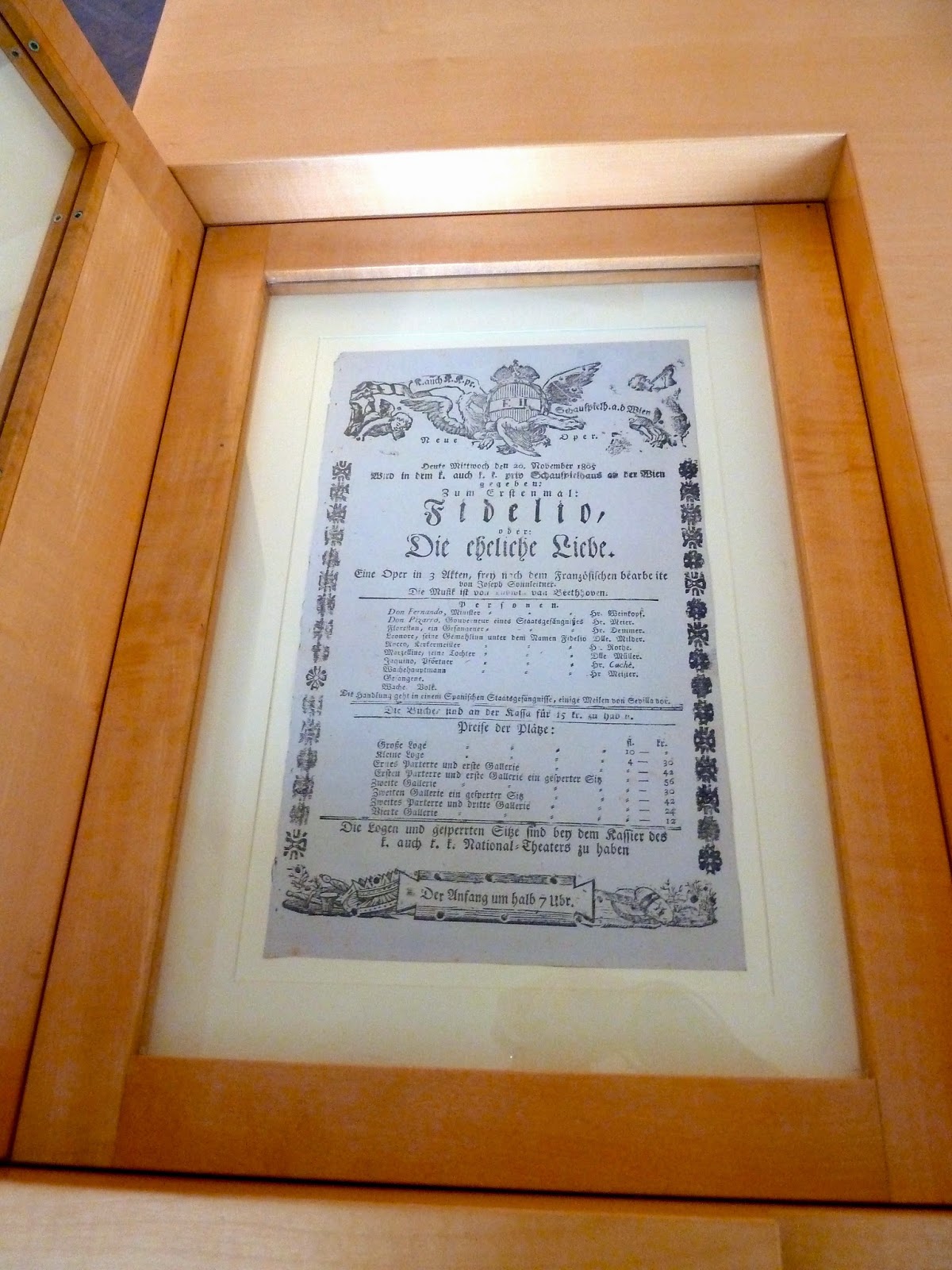
Next stop was Beethoven Pasqualatihaus, an apartment directly across from the University of Vienna. You have to walk up a hill to get there though, because it is perched on top of the Mölker Bastei, the old city fortifications. Beethoven lived and worked in an apartment on the fourth floor for eight years. It was here that he wrote his 4th, 5th, 7th, and 8th symphonies, as well as his only opera, Fidelio. Similar to the Haydn house, the sparsely furnished apartment had been filled with memorabilia. Beethoven’s piano was inside, along with original copies of his music, and many artistic renderings of the composer.

There were also stations where you could listen to the symphonies and opera written in that very apartment. I thought that was a nice touch. It helped me to better understand the importance of the space. Especially since I am not enough of a music buff to know what Beethoven’s 7th symphony sounds like off the top of my head.


Beethoven's piano

A symphony

The libretto for Fidelio

The Schubert Geburtshaus (Schubert’s birthplace) was honestly a bit of a let down. It was farther from town than I had originally anticipated. He was born on a residential street in the suburbs, without much around. Inside you could see the family apartment where Schubert spent his early years as one of 14 children. It was not the place where he grew up though. His family moved when he was still relatively young. The most fascinating exhibit were his eyeglasses. You could also listen to some of his music. I did enjoy comparing and contrasting him with Beethoven.
Schubert's birthplace


The apartment with the listening station


Some pictures of Schubert

My last stop was Strauss’ apartment, which wasn't far from the center of town and overlooked a busy street. It was clear that Strauss enjoyed success as a composer. His apartment was the most lavishly decorated. He lived there for seven years, during which time he wrote “The Blue Danube Waltz,” Austria’s unofficial national anthem. Inside visitors could see his piano, violin, and even a small organ. Since Strauss was so well known, there was even a room full of cartoons in which he was featured. Inside there was another station for listening to his compositions. I thought his apartment had the most personality, and it was my favorite stop of the day.


All of the cartoons


My whirlwind trip around town had taken me to some radically different locations. From Beethoven’s tiny apartment on the hill to Strauss’ lavish city flat, to Haydn’s retired garden house, each one gave some insight into the person who lived there. Unlike a grand palace, when visiting these residences I wasn’t overwhelmed by the sheer beauty of anything. Strauss’ piano was very similar in appearance to Beethoven’s, but the hands that touched them were so different. Here, what was overwhelming was the spirit of those who had lived there before. It was a very immersive way to learn a little more about music history.

Since listening to the music composed by these men at all the locations (except the Haydn house, but I may have not known what to look for) added so much to my experience, I thought I would make a Spotify playlist to go with this post. So here you are. It includes selections from the works I mentioned.